Posts

Showing posts with the label microscopes

How to make a microscopic 3-D image.

Image
This is essentially a bit of fun, but it can have a practical purpose as well. 3D images I've always been fascinated by 3D photographs. Tricking your eyes so that one sees one image and the other sees an entirely different image, is clever. But then when your brain re-integrates those images to form a complete three dimensional structure just spins me out. How? I was vacuuming the floor in the showroom the other day (we have the most wildly exciting jobs) when I found a tiny coil of swarf on the floor. Standing next to a saxon RST Researcher NM11-2000 stereo microscope, I began to wonder how might I take such a photo? I fetched a saxon ScopePix phone adapter and attached my phone to one of the eyepieces. I had to remove the eyecup from the eyepiece to get the phone on straight. I focused carefully and took one photo through the right eyepiece. Then, without moving the sample, I swapped my phone to the left eyepiece and took  a second image. ...
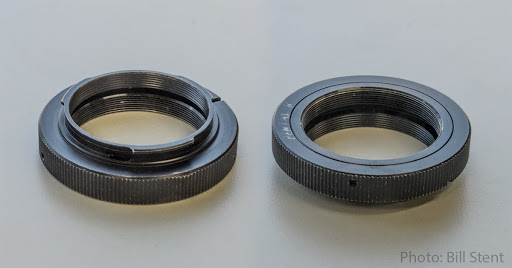
How to put a DSLR camera on a microscope

Image
I know that for a lot of you, microscope photography is second nature, but being the astrophotographer, I'm working at the other end of the spectrum and this is something that's new to me. We sell a range of microscopes. They start as very basic microscopes - essentially for kids and students, and go up to what I might call a middle-range professional instrument, suitable for engineering laboratories, vets, botanists, pest controllers, etc. Nothing like cutting-edge university labs or electron microscopes, sorry. We've also got a number of ways of getting an image from a microscope. We'd prefer to use a separate imager, which is essentially a camera sensor that slides into the eyepiece holder or trinocular head.  We've even got a few entirely digital microscopes, both hand-held or with a screen on a microscope body. If pushed, we can even get a mobile phone camera to the eyepiece. But the other day, a customer asked about how to attach a DSLR to a microscope. I'...

saxon 909EQ2 unboxing video

Image
Following a bit of a shuffle of display stock, I got the chance to make an unboxing video of a saxon Novo 909EQ2. This is the equatorial version of the Novo 909AZ3, and a very popular scope for the serious beginner.  My opinion about this scope is very high. It's got a good long 910mm focal length, which makes it suitable for planets (we like to say that to get a half-way decent view of Saturn's rings you need about a 90 time magnification - and even then it's a small image). It's also got a quite a passable 90mm aperture, which will show you the beginnings of the bright nebulas. Of course, clusters (open ones like the Jewel Box, or Globulars like Omega Centauri) will look very good in this scope, as they are not badly affected by light pollution. Of course, as you might know, I'm totally a refractor man, despite having been wowed by a big Dobsonian on the Orion Nebula a couple of months back. The only drawback (if you could call it that) for a beginner fo...

Round 50c piece

Image
Most of my work colleagues, being the young kids they are, have never seen a round 50 cent piece, or even heard of them. It makes me feel a bit old. After all, they haven't been in circulation since 1967. (I've been in circulation a bit longer.) I came across one the other day in my father-in-law’s old coin collection, and decided to take a photo of it. To do this, I used a USB microscope, a Celestron Handheld Digital USB Microscope Pro . You can see the setup I used in the photo, with the microscope connected to our work laptop. I did have some trouble with the photo, because the coin is larger than the field of view of the microscope when it’s on its stand. You can see the setup here, including the image that was too large for the screen.   So, I had to hold the microscope in my hand and hover it above the coin. That meant I couldn’t get a really good steady square on shot, as my hand drifted about. So, being the geek that I am, I decided to use an astrophotographic technique...

New Australian $50 note - with typo

Image
31 May 2019 Recently we heard that there was a typo on the new Australian $50 note. The $50 note features David Unaipon on one side and Edith Cowen on the other. As a security feature, the note includes microtext (which is a technical term for “really really small writing”) that relates to both of these people. Ms Cowen was Australia's first woman in parliament. On her side of the note, the microtext is an excerpt from her maiden speech, which was delivered in the Western Australian Legislative Assembly on 21 July 1921. Unfortunately, the text as printed on the note contains a typo. In several places, the word “responsibility” has been mis-spelled “responsibilty”. The showroom here has a number of microscopes set up for display, including a couple that hook up to a computer for photography. Being the geek type (all my friends gasp and say “NO!!”) I decided to see for myself. This photo shows the typo quite nicely. To take the photo, I used a Celestron Handheld Digital...