Posts

Showing posts with the label deep space objects

A narrowband Dolphin Head

Image
  This is an image I got remotely. I was in Melbourne, and the observatory is in Central Victoria. It's Sh2-308, which is unofficially known as the Dolphin Head nebula. Can you see it? Because I don't own the observatory or the equipment, I'm not going to go into too much detail here, but this was the rough procedure. I use an all-night script to get data from the facility. In this case, I got about 40 short exposures in red, green and blue, and a heap of long exposures in Oxygen and some in Hydrogen. The background is an HOO palette, where the Oxygen is mapped to the green and blue pixels on your screen, and Hydrogen is mapped to red. I've put the nicely-saturated RGB stars over the top, as HOO stars are yucky.

Frankenscope and NGC1365 - the Great Barred Galaxy

Image
Finally, an image! I've finally got around to processing an image of NGC1365 - the Great Barred Galaxy - that I got from the ASV's dark sky site in Central Victoria a couple of weekends ago. It isn't the best image I've taken, but it's interesting, and it's my first serious image since before the pandemic! But it was a challenge - I made things hard for myself by using two scopes, two cameras and one very rusty astrophotographer.  Frankenscope! The colour information in the image was gathered in 51 five-minute exposures using a colour camera on a Sidereal Trading modified telescope. This is one crazy machine.  The front half - the objective - of the scope is a saxon 102mm FCD100 triplet, which is a beautiful piece of glass. We removed the somewhat unworthy focuser and replaced it with an Astroworx Crayford focuser made in our own factory. This focuser will soon be launched onto the market, and we hope it will do well. The guide scope was made by Sky-Watcher, t...

John Iramiyan's M16, the Eagle Nebula in narrowband

Image
Just take a look at this photo of M16 - the Eagle nebula. The Pillars of Creation are right in the centre of the image, and to the left there's the Stellar Spire. Note the horseshoe shaped structure at the top of the nebula - I'll get back to that. John uses a saxon 127mm FCD100 triplet refractor. This is one of the big ones. For an imaging array, John uses the popular ZWO ASI1600MM-Pro monochrome camera and shoots through narrowband filters. All his exposures are four minutes long. John has presented his image in the so-called "Hubble Palette", where images taken though the Sulphur filter are shown as red, those taken though the Hydrogen alpha filter are shown as green and those taken through the Oxygen filter are shows as blue. As a contrast, here's one of my own photos of M16. It's taken with similar equipment, an ASI1600MM-Pro, a slightly smaller 107mm triplet refractor and narrowband filters, which are presented using the Hu...

When things go too well ... at first. Vela supernova remnant.

Image
Do you remember those old TV westerns where the hero whispers "it's quiet... too quiet"? During the Easter break, I went to the dark sky site to photograph the Vela SNR (that's supernova remnant, not signal-to-noise ratio). This fibrous structure shows well in Oxygen and Hydrogen, but I don't think there's much Sulphur, so I decided to do a bicolour image. Things went swimmingly. I'd polar aligned, centred on the target, and taken a couple of test images through the two filters before it got properly dark. When the time came, I chilled the camera and began taking images. Guiding was going well, and a meridian flip went flawlessly. After this, it was about five hours of just steady as she goes. During that time, the rig would refocus every hour and change to a Hydrogen filter. I didn't have to do anything until about 3:30am when I would cover the scope for calibration photos. It was going so well I decided to retire to my tent. I woke...

Steve Miller’s Antares

Image
This is what you can do with a small star tracking device. Steve from Tassie recently got himself a Sky-Watcher Star Adventurer, which is like a small equatorial mount designed to carry a camera and normal lens. Steve used his Lumix G9, a micro four-thirds camera with a 200mm f/2.8 lens. This gave him the equivalent of 400mm focal length for a full frame. Using ISO 1250, he took 12 30 second exposures, which he stacked using Affinity. Final touches he did in Apple photos. As to the photo, it’s one of my favourite areas in the sky, the end of the Rho Ophiuchi dust trail. There’s so much there. Just for fun, I've put an annotated version of the photo at the bottom. The bright yellow star is Antares, the eye of the Scorpion. Above and to the left is the globular cluster M4, but between them is the smaller cluster NGC 6144. Continuing anti-clockwise, Alniyat is next, and then the smaller star HIP 80079 to the left of the shot. Below this is (for me, at least) the star of the show, Rho ...

Pareidolia - seeing things that aren't there

Image
Do you suffer from pareidolia? Nearly everyone sees objects in clouds. Some people see faces in toast. My wife says that, as a child, she used to see teddy bears' faces in knot patterns in her bedroom's wood panelling. Your brain is very good at making out objects in backgrounds, even when the object isn't actually there. It doesn't have to be images that our brains try to make sense of. Norwegian farmers feared the Fossegrime, a spirit that lived in waterfalls, luring people through sound. In the white noise coming from rushing water, our brains can nearly make out speech. Victims of the Fossegrime, looking for the source, would come nearer and nearer the dangerous waters, eventually to be taken by the malevolent spirit. The Moon is a fertile source of pareidolic images. A while back I wrote a piece on the "Lunar X" , as well as a few other features. Certainly, everyone has heard of the man in the Moon. That image doesn't stand out quite so much here in ...

The Bat and Squid Nebulas from Germany

Image
Here's a photo from a friend, Pete, who lives in Germany. It's a story of collaboration between different objects. Peter got into astrophotography in 2014, and has steadily developed has talents and equipment ever since. Like most of us, he started with a DSLR, but now uses a dedicated astrophotographic sensor. He also has two triplet refractors that he uses from a fixed pier. The first collaboration is the object itself. Clearly, there are two separate structures here. The red nebula is Sh2-129, or the Flying Bat. The blue nebula is the very recently (2011) discovered Ou4, or the Squid.  Apparently, both occupy the same area in space - one is not behind the other. The only sad part is that you can't see any of this from Australia. The Squid Nebula gets its shape from jets from the triple star system in its middle. The blue shock-waves are rich in ionised Oxygen, which is very dim. It's no surprise that the Squid was only discovered in 2011. In contrast, the Bat is very...

Shaun's Carina

Image
Have a look at this shot of the Carina Nebula. It was taken by our mate Shaun. Shaun has been a photographer for ages, and has a pretty large collection of equipment to prove it. He's mostly been into wildlife and air show photos, but a long-time fascination with things astronomical led him to start his journey into astrophotography last year. Like me, Shaun uses an NEQ6 equatorial mount. Unlike me though, this was his first-ever mount. Clearly Shaun is not one of the faint-hearted. For a telescope, he started with a Sky-Watcher Star Travel 120 doublet refractor (which is the same as a saxon 1206) coupled with a DSLR. It wasn't long before he realised that he wanted to dive into the deep end with narrowband images. He tells me that these can show the wonders that exist in the universe - well beyond what our eyes can see. For the technically minded, the image was taken using a saxon 80mm FCD100 triplet refractor, coupled with a ZWO ASI1600GT. This is a relatively new camera from...

Wide-field Astrophotography with a Vixen Polarie

Image
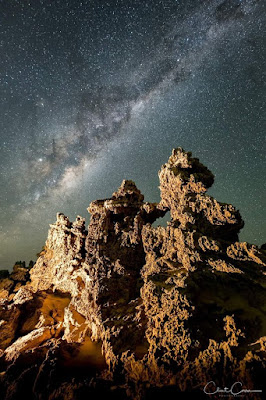
Our recent competition for wide field astrophotography was won by Clint Conn, and I’ve attached his photo here. Stunning. I’ve taken a few in my time, but never this good. To take a photo like this, you can use a simple tripod and a camera. But you can’t expose for longer than about 30 seconds (depending on your focal length) before you start to get star trails. These can look nice, but if you don’t want them, it’s awful. You have to stop the stars’ apparent motion. A gigantic equatorial mount under your camera would do the job, but that's bulky and expensive. What's worse, your camera would look a bit ridiculous on top of a thumping great machine. You need a simpler and less expensive gadget that tracks the stars. There are several types out there, such as the Sky-Watcher Star Adventurer, or the Vixen Polarie.     You align them to the South Celestial Pole, and once they’re set up, they enable you to take photos of the sky using a camera and a normal lens. To ...

Anne Marie McComb's Sh2-308

Image
Anne-Marie McComb has produced a fantastic demonstration of what extra time does for a faint image.  This emission nebula has a couple of different names, all of which are confusing. Officially, it’s known as Sharpless 2-308, but is known as the Dolphin Nebula. It really does look like a dolphin. Problem is, there’s another Dolphin Nebula out there, and that one is really hard to see from Australia. This nebula is typical of those formed by Wolf-Rayet stars. At an early stage in their lives, these stars act like most others, shedding material outwards as they age. However, something causes these stars to suddenly blow gas out at a far faster rate, and the fast-moving gas catches up with the slow-moving gas from before. That’s what causes the bubble-shaped nebulas. However, that’s not what Anne-Maree is trying to show. You’ll see that the two images here are similar, but one has far more of the dim details. This is all to do with signal-to-noise ratios. The longer exposure has m...

Satellites over the Horsehead

Image
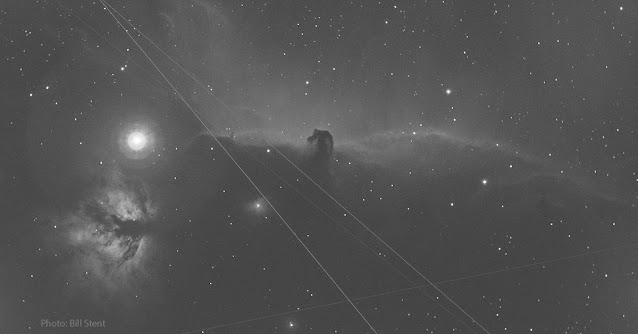
  I guess most of you have heard about how Elon Musk’s SpaceX company has launched a second “train” of satellites, augmenting the ones sent up last month. The photos and videos look pretty freaky. You’ve probably also heard astronomers and astrophotographers moaning about it. Well, just how much of a problem is it? A quick answer is in my photo. I was up at the dark sky site a short while back, photographing the Horsehead nebula. Just as an aside, the Horsehead is my all-time favourite object, just pushing out the Fighting Dragons. I know it’s a lot of people’s favourite too – but it’s undeniably super cool. But I digress… I was taking five-minute sub-exposures using my three various narrowband filters. All up, I got about 50 of these for stacking, which I thought was a pretty good haul for a Summer night. But as you can see, I lost four of my subs to satellite photobombing. I’ve stacked the four frames I lost into this photo. I don't even think these are SpaceX satellites...

James Baguely's phone images

Image
30 December 2019 Yes, you can use a phone to get deep sky objects! People often ask me what is the best camera to use for astrophotography. The answer is fairly complex because of factors like setup and cost. But there's a saying that the best equipment is the stuff you reach for first. In this case, that camera is an iPhone 11. James lives in Canberra and recently got himself a telescope - a 10-inch go-to Dobsonian. This scope is actually designed for visual work, but after James was knocked out by what he saw through the scope he decided to try taking photos. He got himself a saxon ScopePix mobile phone adapter and started experimenting. He learned pretty quickly to use the 3-second count-down timer on the phone, and then found that a 10-second exposure in night mode on the iPhone’s native camera app worked best. The fact that it’s a newer model phone helps, as the new ones are much more sensitive to low light. Once set up, the Dobsonian tracks the stars on its ow...

Summer solstice

Image
20 December 2019 In my post on the Spring equinox I mentioned it was a pretty sparse time for astronomers. Well, that's over, and the Summer glut of things to catch is here! Start with 47 Tuc, the Pleiades, try the Sculptor Galaxy, then a bit later move to M42, the Great Nebula in Orion, and just go from there. The one I'm waiting for this year is the Rosette Nebula. The Rosette itself might be too dark to see with anything but a large telescope, but it also has a pleasant star cluster in the middle. It's also huge, 1.3 degrees, so you'll need the longest eyepiece you've got. This is suited to a Dobsonian telescope which has a low focal length and wide aperture. Here's the list - as usual I'm giving you the name as well as its rough transit time - the time on the 21st when it's highest in the sky. Some of them don't set. My poor photo is the Horsehead and Flame nebulas in narrowband. Globular cluster: NGC 104 - 47 Tucanae (07:55 PM) G...

Deanne's first light photos

Image
16 December 2019 This is a first light photo with a difference. First light photos are photos taken with something new. They might be taken with a new scope, or a new camera, or something else. In this case, it was a first photo taken with any telescope. No kidding. But there’s a story. Deanne is already an accomplished photographer, being in the Australian Institute of Professional Photography. She has a number of awards already, and has taken wide field shots using a wide lens. On a visit to Mt Burnett she met Andrew Campbell (of Andy's Astropix) and through him, discovered astrophotography through a telescope. She was hooked, but as with other astrophotographers, Dee found that she had to wait before she was able to afford the equipment she wanted. Finally, however, Dee turned up at the shop and came away with a big saxon 250DS Newtonian and a saxon AZ-EQ6 GT Pro. Dee joined the ASV, and the learning started. After she put the scope up at home and became familiar with ...

Joanne Tucker's photos

Image
18 November 2019 One of the things I especially like writing about is the development of skills in this hobby. More than any other pastime, the demands of astrophotography - precision, care, understanding and patience - create a pathway where beginners develop into skilled users of the equipment. In particular, and I've mentioned this for others before - you don't need to have high-end equipment if your skill level is high. I met Joanne the other day when she came into the shop to upgrade an equatorial mount. She had a Sky-Watcher Star Discovery mount on which she could put either a 127 Maksutov or an Evoguide 50ED scope. This was what she was using for deep sky objects. I was impressed when Joanne told me she was getting photos using a goto alt-az mount, but you remember Josh Carnovale proved it was possible this year. But then she showed me the photos and I was stunned. These are next level stuff. She sent me some, and I said I'd publish three. I've attached...

Narrowband Helix

Image
23 October 2019 Remember a couple of weeks ago I posted my narrowband Helix photo? Well a while later, ASV member Geoff Healey posted a visible light photo of the same object. It's labelled "LRGB". Compare the two photos here. My photo (HOO) is an image captured using two filters that only pick up a pair of highly specific colours. One colour, a pinkish "Hydrogen" is displayed as red on the computer screen, and a teal "Oxygen" is displayed on both the blue and green pixels on the screen. If you look closely, they're quite different. Geoff's images is "true colour" and mine is "false colour". But there are a couple of other differences. You'll note that Geoff's image has lots more stars in it than mine. Geoff's camera accepts the whole spectrum, so it allows a lot more light in, including light near infra-red and ultra-violet. My filters accept light from the nebula but shut out a lot of the rest - to ...

Andromeda

Image
18 October 2019 The other day I read on the ABC website that our Milky Way galaxy is likely to be “eaten” by Andromeda . If there’s one thing I can’t stand, it’s clickbait. No, we’re not all about to die. First, it’s not expected to happen for another 4.5 billion years. So I wouldn’t be too fussed about it if I were you. Second, galaxies might look pretty substantial, but honestly, they’re not. Probably the most crowded place I can think of in the current universe would be a globular cluster, such as Omega Centauri (this is my shot). To give you an idea of how crowded these places are, Alpha Centauri, the closest star to the Earth, is about four light years away. The stars in a cluster like this are about one light year apart on average. Of course, in the densest part, they’re much closer - down to one light day apart. Life as we know it (Jim) in there just wouldn’t be possible. Star collisions here are a genuine possibility. Not only that, any planet would be torn away from ...

Adrian Stanyer's Sculptor Galaxy

Image
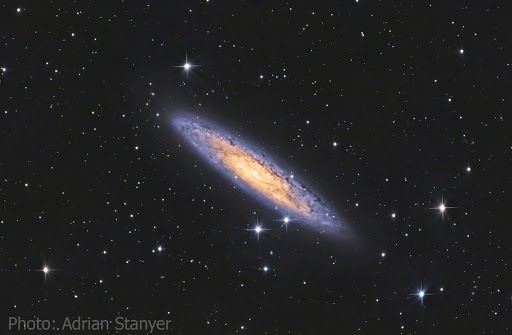
9 October 2019 This is the best time of year for NGC 253, the Sculptor Galaxy. Here’s a terrific image taken by our mate Adrian up at the ASV’s dark sky site a couple of weeks back. I was up there on the same night. Adrian uses a saxon 200DS Newtonian, which he got from Optics Central about a year back. It has a pretty fast focal ratio of 5, which means it’s good for photography. It’s on a saxon NEQ6 mount he got at the same time. You can see it below. This alone is a great setup. But he's upgraded it. Adrian has a ZWO ASI294MC, a colour camera with a “four-thirds” size sensor, similar to a DSLR but more sensitive to near-infrared colours. The large sensor combines with the scope's 1000mm focal length to give a nice wide field - which is good for large nebulas. On top of this an IR cut filter helps with that awful “star bloat”. Since buying the mount and scope, Adrian has added a laptop computer, which can replace the mount’s hand controller. Having the computer also me...

Helix Nebula in bicolour narrowband

Image
Last weekend, I got up to the dark sky site. It was the first time I'd been up there on a weekend for about a year, due to work commitments. Normally, I go on a Wednesday night and there is rarely anyone else there. It was both a new moon and a long weekend. I was still surprised by how many people were up there; there were probably 20 people in total, including several kids. Most of them I knew already, and it was marvelous to catch up with them all again. That's one of the things I like about astronomy and the ASV, it's a very friendly bunch. The target for the evening was NGC 7293, the Helix nebula, and I intended to get a full narrowband photo, made up of sub-images taken through Hydrogen alpha, Oxygen III and Sulphur II filters. I set up on a pier, threw a towel over the scope to keep the sun off it and went and socialised while I waited for sunset. Once the stars began to come out, I did my polar alignment, set up my auto focus and found the target. It'...

Spring equinox

Image
The Spring Equinox might be great for bird watchers, but it’s pretty slim pickings for astronomers. The list of things to look for isn’t as long as at other times of the year. Not that there’s nothing to see, of course! Here’s my list of springtime objects. Remember, new Moon is the best time for seeing the dimmer targets such as the nebulas. Remember also that the size of the target will determine how well you’ll see it in any particular scope. Sometimes magnification isn’t your friend! The list is ordered by the time targets pass the meridian – that is, their highest point of the night. So the Omega Nebula is starting to set after 6:45pm, so look for that one first. Also, depending where you live, some of these targets are “circumpolar”, meaning they don’t set at all. To this list you can add a number of summer objects, as Orion is rising in the early morning even now.  I’ve already seen a few photos of the Orion and Horsehead nebulas published by keen astronomers. This...