Posts

Showing posts with the label ASV

Asteroid Apophis - existential threat or spectacular sky show?

Image
This blog was posted (slightly edited) as an article in Crux, the Magazine of the Astronomical Society of Victoria, vol.39 no.2 April 2021. Our neighbours the asteroids Asteroids are pretty much everywhere in our solar system. Typically, they have highly elongated orbits, meaning they can cross the orbits of the planets, as the planets have much less eccentric (that is, nearly circular) orbits. There are several classes of asteroid, determined by the amount if time they spend inside or outside Earth's orbit. Atira - spend their entire time inside the Earth's orbit Aten - cross Earth's orbit but spend the majority of time nearer to the Sun Apollo - cross Earth's orbit but spend the majority of time further out than the Sun Amor - spend their entire time outside Earth's orbit Most of the Atira and Amor classes are quite safe, although some of them can approach Earth's orbit closely. However, the Aten and Apollo types don't only approach, ...

Photographing the asteroid Apophis

Image
Never heard of it 99942 Apophis is an asteroid whose orbit - somewhat worryingly - intersects the Earth's. It's defined as a hazardous object. Apophis orbits nine times for every eight Earth orbits, and because of where the intersection is located, the danger period is every eighth April. Wait, what? The intersection is on the ascending node, meaning Apophis approaches the Earth from "below" (assuming Earth's northern hemisphere is "up"). This means Apophis is visible from the Southern Hemisphere before the encounter, and it falls below the horizon, becoming visible from the Northern Hemisphere after the encounter. There's a super close (but safe) pass coming up in April 2029, meaning about now is the last encounter before then. So of course I want a photo In preparation for writing an article about the asteroid, I wanted to actually get a photo of it. Because it's not a very close pass, it wanders by rather than zooms, and so I had a good...

ASV Messier Star Party 2021

Image
I'm an introvert, and I do like it this way. One of the things about introversion is that it lends itself well to astronomy (as well as birding) as pastimes. I like being alone on the astrophotography field, working at my images, solving problems (which are legion), and watching images come down. However, humans are social creatures. I don't want to do the solitary thing all the time. Most interaction I have with other people in the hobby is done through social media, which is good, but it's not as good as being face-to-face. It also doesn't help when you have a problem and need advice. Any help I get on social media comes from someone who is hearing about my issue distantly, removed in both time and space. Twice a year, the Astronomical Society of Victoria holds star parties. They're held up at the ASV's dark sky site in Central Victoria. The latest one was in March, and a couple of hundred people turned up, including a limited number of non-members. I to...

A look at the Sun, including the amazing Doppler effect

Image
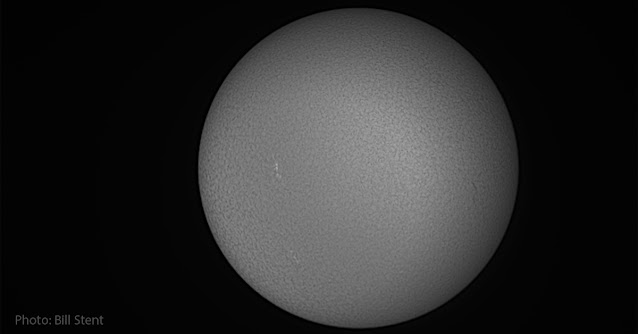
It's lockdown in Melbourne (still) and I'm looking for something to point a telescope at. I've sworn off deep sky targets for the time being, as the light pollution in the city here makes anything I produce - even narrowband - look blah in comparison to images taken from the dark sky site. I've also been taking photos of planets, but I left the Celestron 8 at work. Besides, (and I might be getting a little controversial now) there's a difference between nebulas and planets. Once you've taken a great image of a planet (not that I have yet) it gets a bit repetitive. There's not that many of them (sorry, Pluto). But wait - there's the sun! I pulled out my trusty solar telescope, a Coronado PST. This type of solar telescope doesn't work in the same way as a solar film filter. A solar film is an example of a neutral density filter, which turns down all the colours (frequencies) of light to more or less the same extent.  A solar telescope cuts out all ...

ASV's Star-be-cue and some lubrication

Image
Last month I went to the ASV’s Star-be-cue. The weather didn’t really play the game, and for most of the evening we were dodging clouds. But star parties are mostly social occasions, and a chance to meet up with other astronomers. They're also a good opportunity to see other people’s equipment and how they use it. While I was there, I got talking with a couple of people with a saxon Novo 909AZ3. They were watching M42 - the Great Nebula in Orion. Nearby, another group of people were also on M42 but through a saxon 8” Dobsonian. I had a saxon Hyperion 1021EQ3, so it was a great opportunity to compare scopes. The 909 and the 1021 produced very similar images. Although M42 was visible, it wasn’t very extensive. However, because these are both refractor telescopes, the “trapezium”, those four baby stars in the middle were sharp and bright, clearly separated from each other. The Dob gave a very different view. M42 was wide and very distinct. You could see wisps of it extending on b...

Birds at the dark sky site

Image
27 December 2019 As you probably know, not only am I an amateur astronomer, but I'm also a bird watcher. My wife says I really only have one hobby - expensive optical equipment. While I've talked - at length - about the Astronomical Society of Victoria's dark sky site near Heathcote (Vic) before, there is an aspect of it that I don't think I've mentioned. Without being too specific about the location of the place, it's away from any built-up areas and surrounded by box-ironbark forests. This means birds. The birds there are great. The big problem is hats. If I'm wearing my astronomer's hat I tend not to concentrate on the birds, either because I'm setting up, tearing down, or being otherwise distracted by people or dinner. I spotted this bird on my most recent trip. I initially thought it was a Restless Flycatcher, but on closer inspection it turned out to be a Hooded Robin. While I was photographing him, I also got a rather poorly-li...

ASV Star-be-cue

Image
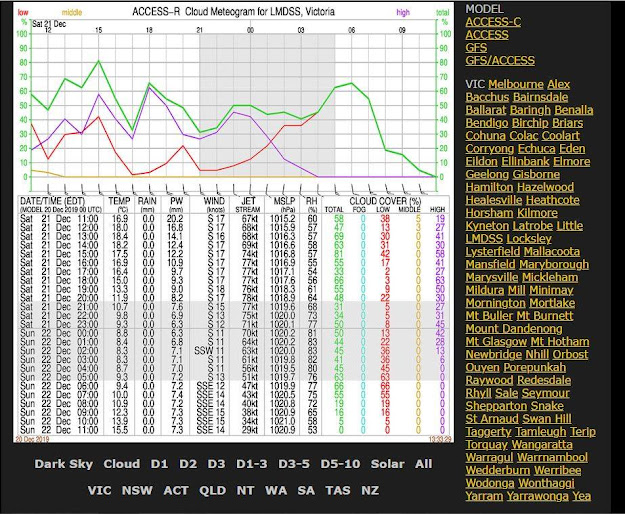
20 December 2019 ASV Star-be-cue weather forecast is good - well, a lot better than it was a couple of days ago. We've got an updated meteogram for the ASV's dark sky site for tomorrow's Star-be-cue. A few days ago the forecast was for 100% cloud all night. Because of this, some people were considering not coming. But worry not! The cloud is now forecast to be less - certainly enough to do at least some astronomy. Besides, part of the reason for the Star-be-cue is to catch up with fellow astronomers, so my advice is to take the risk. You'll have a great night, even if you don't see as many stars as you might have. I'll be there - a bit late though, as I have to work here until 4pm - so probably after 6, depending on traffic.

Deanne's first light photos

Image
16 December 2019 This is a first light photo with a difference. First light photos are photos taken with something new. They might be taken with a new scope, or a new camera, or something else. In this case, it was a first photo taken with any telescope. No kidding. But there’s a story. Deanne is already an accomplished photographer, being in the Australian Institute of Professional Photography. She has a number of awards already, and has taken wide field shots using a wide lens. On a visit to Mt Burnett she met Andrew Campbell (of Andy's Astropix) and through him, discovered astrophotography through a telescope. She was hooked, but as with other astrophotographers, Dee found that she had to wait before she was able to afford the equipment she wanted. Finally, however, Dee turned up at the shop and came away with a big saxon 250DS Newtonian and a saxon AZ-EQ6 GT Pro. Dee joined the ASV, and the learning started. After she put the scope up at home and became familiar with ...

Christmas Star-be-cue

Image
13 December 2019 Christmas Star-be-cue at the ASV's dark sky site, 21-22 December! I'm always spruiking the Astronomical Society of Victoria to people starting out or getting further into astronomy. If you want to see a bit more about what the ASV is about, meet other keen astronomers, see their kit and look through some monster telescopes, then here's your chance. The ASV has a couple of events up at its dark sky site each year, including this big Christmas event. It starts at noon on the 21st and goes all night (obviously). The dark sky site is near Heathcote, about two hours' drive from the CBD. Along with a bunch of other astrophotographers, this is where I take my photos from, so come up and have a look at the place. Places for non-members are NOW FILLED. Of course, if you're an ASV member (like me), then you can just rock up. (I'll be late as I'm working at Optics Central that day.) During the day, there will be solar observing (using a spe...

Helix Nebula in bicolour narrowband

Image
Last weekend, I got up to the dark sky site. It was the first time I'd been up there on a weekend for about a year, due to work commitments. Normally, I go on a Wednesday night and there is rarely anyone else there. It was both a new moon and a long weekend. I was still surprised by how many people were up there; there were probably 20 people in total, including several kids. Most of them I knew already, and it was marvelous to catch up with them all again. That's one of the things I like about astronomy and the ASV, it's a very friendly bunch. The target for the evening was NGC 7293, the Helix nebula, and I intended to get a full narrowband photo, made up of sub-images taken through Hydrogen alpha, Oxygen III and Sulphur II filters. I set up on a pier, threw a towel over the scope to keep the sun off it and went and socialised while I waited for sunset. Once the stars began to come out, I did my polar alignment, set up my auto focus and found the target. It'...

The competition to name the star HD38283 and the exoplanet orbiting it

Image
Note that this blog post was rewritten to reflect that the planet has been named and the competition website has now been discontinued. A southern-only star, with a planet discovered by an Australian astronomer at an Australian observatory – well of course it has to have an Australian name! In August 2019, the Melbourne Age had an article about how the International Astronomical Union has asked Australia to name a planet, along with the star it’s orbiting. But Planet McPlanetface? Oh, change the record.  The competition The star itself is pretty unassuming. It’s not visible with a naked eye, and currently only has a catalogue name - HD38283. But if you know where to look, and have a pair of low-power and large objective binoculars (say, a 7x50), you can actually see it. Being out of the city would help a lot, too, as it’d take a lot of finding.  This is a screenshot from the free planetarium program Stellarium that shows HD38283 in relation to the Southern Cross and Carin...

What is false colour?

Image
8 May 2019 What is colour? A strange question maybe... Recently I took a photo of NGC 6188. The Fighting Dragons of Ara is one of my favourite nebulas. I'd got a test shot last year in black and white, and really wanted more. I went up to the ASV dark sky site and got over 6 hours of images through my three narrowband filters. Then I roughly processed what I'd got on my computer. I used the free program Deep Sky Stacker to create stacked and aligned images from each filter, then recombined them in Photoshop using the "Hubble palette". Images taken through the Sulphur filter end up as red in the final image, Hydrogen goes to green and Oxygen goes to blue. This is a "false colour image". If you were there, it wouldn't look like that. If you could see it at all, it'd probably be pink. I put the photo on the ASV Facebook page, and there was some some discussion about the green colour. It's not that it's wrong, just ... unusual. One a...