Posts

Alpha Centauri

Image
31 December 2018 How well do you know your neighbours? Alpha Centauri (Rigil Kentaurus, or just Rigel Kent) is not just a single star. It’s not even a double, it’s probably a triple. Alpha Centauri A and B appear as two stars very close to each other in a telescope. You have to have a scope with a long focal length to be able to split the two. When I was a kid, we used to judge how good people’s scopes were by looking at Alpha Centauri to see if the scope could split the binary pair. To do it, the scope needed a lot of light gathering ability, good optics, and a long focal length. That probably also suggests a lot about what I was like as a kid. The distance between these two stars is only about 11 times the distance between the Earth and the Sun. The pair dance with each other, taking about 80 years to complete a do-si-do. Any planets nearby would be well cooked. Their poor neighbour, Alpha Centauri C, is dull red, nearly invisible and also about 0.2 light ye...

Starting out in astrophotography?

Image
28 December 2018 It's intimidating, sure, but there are people to help, and it doesn't need to be expensive. Bill's written a blog post about how he got started, including some of his early photos. He discusses some of the choices that beginner astrophotographers face, as well as a couple of pitfalls to avoid, and (importantly) how to avoid spending lots of cash up front.

Lunar X

Image
26 December 2018 Have you seen the Lunar X?   This is a light effect that happens on the Moon at the most once each month. However, due to the Sun's position as well as the Earth's spin, it's only seen from any particular part of the Earth a few times each year. Bill's latest blog shows his photos of it , how to see it, how to photograph it, and when it's going to be visible from Melbourne during 2019. You can also watch a video on the Optics Central's YouTube channel.

Earthrise

Image
25 December 2018 Today is the 50th anniversary of this, one of the most famous photos of all time. Earthrise, taken by Bill Anders, one of the astronauts on Apollo 8 has come to represent how alone humanity is, as well as how dependent we are on a single planet. The photo was taken on the 24th of December 1968 with a Hasselblad 500EL/M camera with a roll of 70mm Kodak colour film. Merry Christmas to all our customers and friends! Photo: William Anders / NASA

Ever seen a red rainbow?

Image
24 December 2019 Rainbows happen when the white light from the Sun is refracted by raindrops in the air, a bit like the triangular prism on the front of the Dark Side of the Moon album. But what happens if the sun is very close to setting, and the dust and atmosphere has blocked out all the blue end of the spectrum, giving the red colour of a sunset? Well, this happens. The light that does hit the raindrops gets refracted, but there's no green or blue in the rainbow.   In telescopes and binoculars, this refraction is undesirable, and called chromatic aberration. Doublet and triplet refractor telescopes have specially designed lenses that counter this.

Farout and Planet X

Image
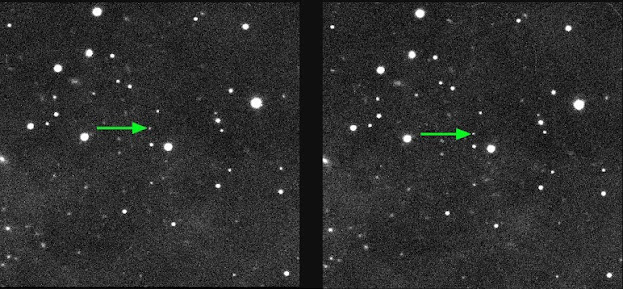
21 December 2018 Astronomers at the Minor Planet Center at Harvard University have discovered another minor planet way (and I mean WAAAY) out in the solar system. Perhaps not surprisingly, they've nicknamed it "Farout", but its official name is the rather unromantic 2018 VG18. It was discovered (and then confirmed) photographically. Two photos Were taken of the same area of the sky at different times and then compared. The photos are below, with Farout marked with the green arrows. Notice how it's moved a bit? Farout does move very slowly, taking about 1000 earth years to complete an orbit or the sun. Astronomers hope that by watching Farout and learning more detail about its path, they'll get closer to finding the mysterious Planet X, which they are pretty certain is out there somewhere. I took a similar pair of photos of Uranus a couple of months ago, including its two major moons, Oberon and Titania. It doesn't need a very big telescope, b...

Venus is going visiting!

Image
17 December 2018 For those of you who are up early and looking east, Venus is now moving away from the Sun and will be very bright over the next few weeks, rising before dawn. On 4 December it was very close to the nearly-new Moon, which looked very photogenic. But you haven't missed out! On 2 January 2019 it'll happen again, only Jupiter will be also joining the parade. Then on 23 January, Venus and Jupiter will be right next to each other in the morning sky, both just adjacent to Scorpio as it rises. On 1 February Venus will be even closer to the razor-thin moon - only two moon widths. That'll be a magnet for the photographers! This is the only photo I've ever taken of Venus. At the time all I could say was that it was about the right shape. To get a good look at it, you're going to need a pretty long focal length, say better than 1500mm. For this type of job, nothing is really better than the Cassegrain or its variant, the Maksutov. What's the...